Visit the composting facility in Sarabetsu village
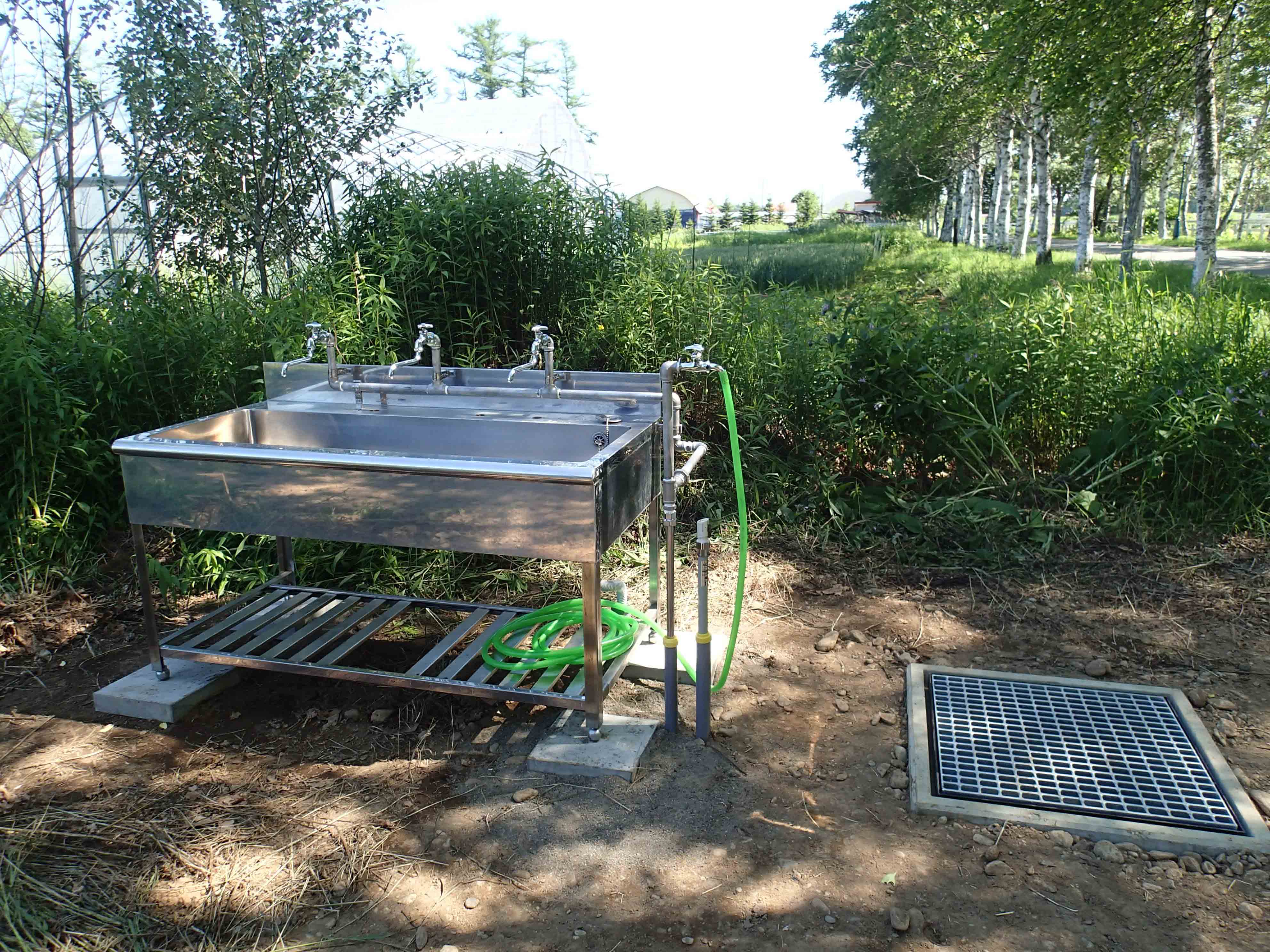
Today, I went to Saravetsu village with JICA soil diagnosis course participants to see the composting facility of the village.
The village is located about 30 km south to Obihiro city.
Sarabetsu village started a compost producing project using the agricultural wastes produced in the village around 25 years ago in 1989.
The project has contributed to the sustainable and environment friendly agriculture practiced in the village.
For further detailed information, please see the following documents.
Compost producing facility in Sarabetsu village: power-point pdf
Compost producing facility in Sarabetsu village: word-text pdf
Three weeks
Three weeks have passed since I started my home page on June 23.
Thank you for visiting my home page. Around 1,500 accesses have been counted on my site,
but the actual number of visitors may be one third of this.
Most of the people spend less than 10 seconds to visit my site.
I have to make my site more attractive and comprehensive to be understood in short time.
Anyway I understand that the person who is most happy with this site is myself.
I can also imagine my intimate old friends reading this site. For them, I should upload my bests.
I have uploaded many lecture files, but I have still more files to be uploaded.
Due to the frequent changes made in the curriculum of my university, I have undertaken many lectures by now.
For the lectures before 2005, "Land use science", "Soil Chemistry" and so on, I have no powerpoint files.
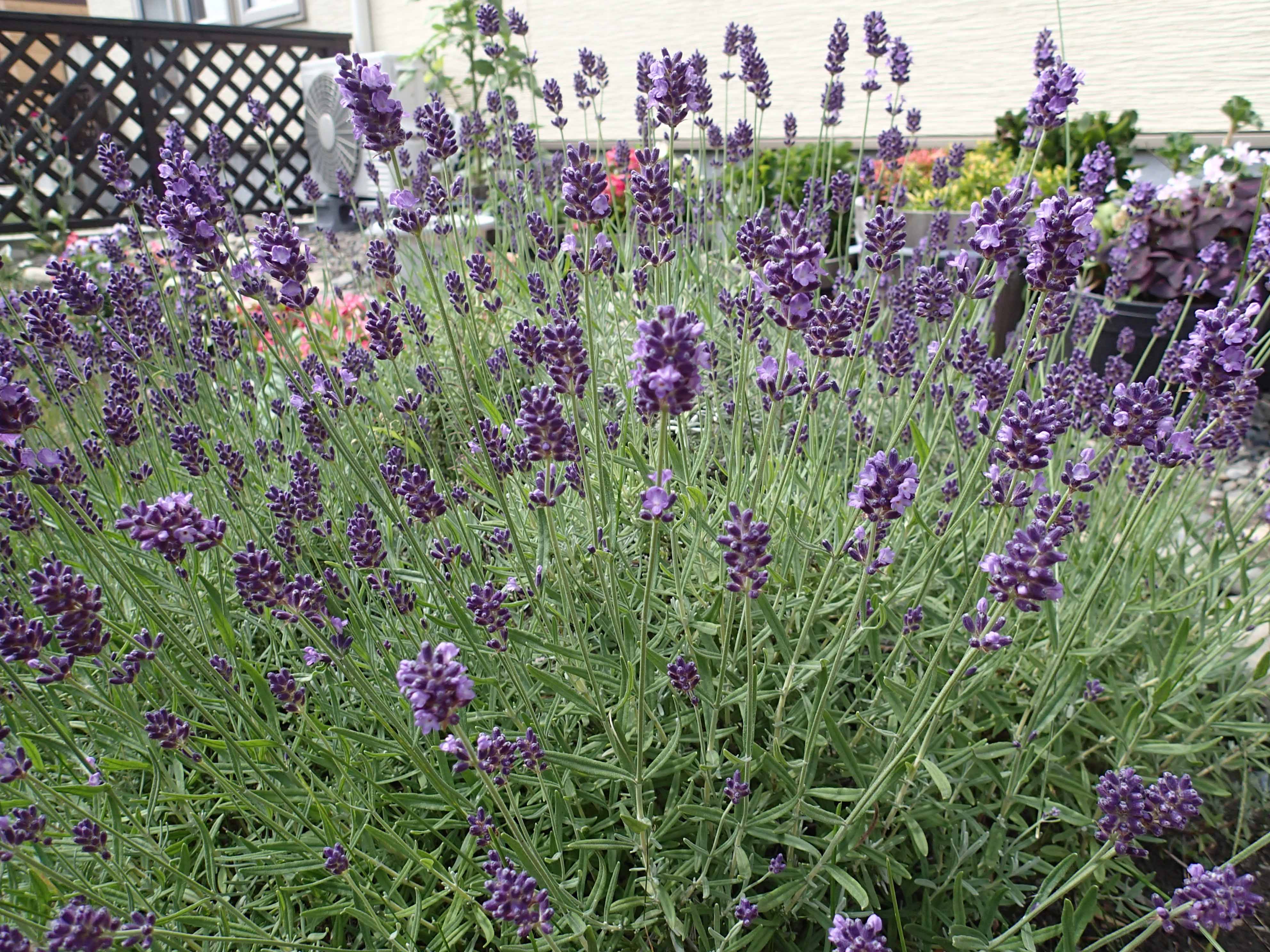
The photo below is lavender in my garden. Within July, I can enjoy the beautiful blue color and good smell of the flower.
This afternoon, I accompanied my wife to see a documentary film entitled “Atomic Mom”.
It was a story of a lady scientist who have engaged in the study on the effect of radio-activity on animals at the US Navy institute.
She kept secret what she was doing during her duty, but her daughter recorded her mother’s confession after many years into a film.
The daughter was engaged in the business of film production and also have long considered the meaning of atomic bomb development,
which enabled the accomplishment of this film.
The daughter also traveled to Japan and had a contact with the atomic bomb surviver (a lady and her daughter) and interviewed them.
Today, the film director, Ms. M. T. Silvia came to the auditorium hall in Obihiro, and we could hear the speech of the director.
Her mother had believed that she was working for the justice and scientific truth while she was working,
but after her retirement she regretted her activity on her duty, and thought that
she might have only contributed to the development of atomic weapon.
However, she could tell nobody what she was feeling, because she swore to the US Navy
that she would never tell anything what she experienced on her duty.
I learned that the top politicians of nations are always unaware of the lives of people or animal,
whether they belong to their own nation or to enemy nation. For them, the first priority is to win the enemy,
and anything else may be sacrificed for it.
This film can be seen only in a special occasion organized by the people who want this film to be seen by more people.
I was happy that I could see this film today.
I thought the film director and her mother scientist are both great.
I recommend my friends to see this film if they have a chance.
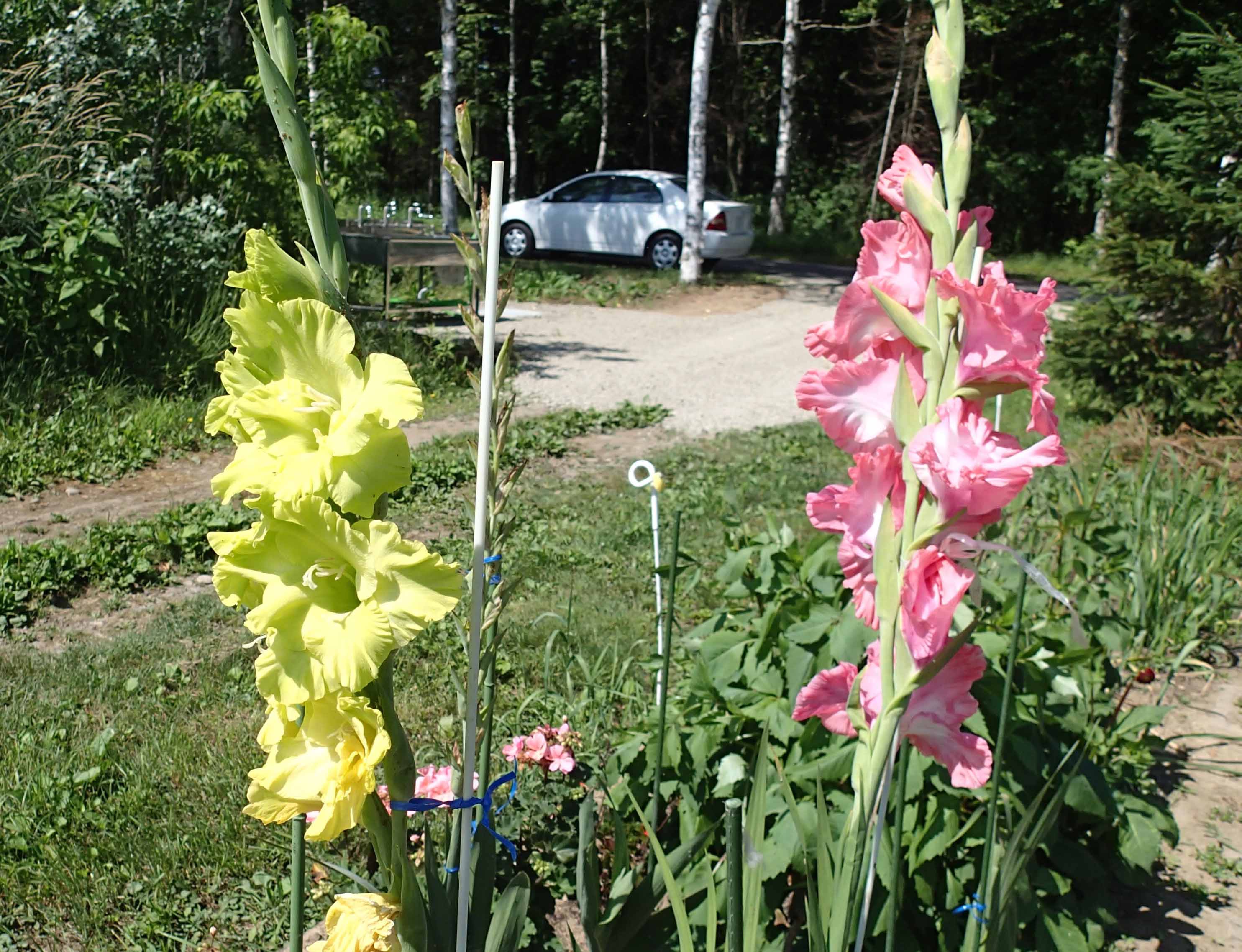
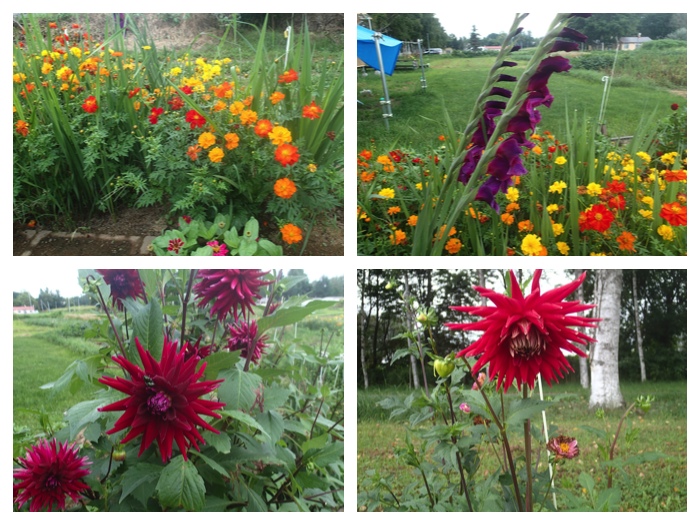
The photo below is gladiolus flowers in the field of junior course in my university.
I visited there this morning.
Though none of my friends has answered to my quizzes about squids, I give here the answers.
1) The squid has three pieces of very important organ which most of other creatures have only one. What is that?
Answer: Squid has three hearts. Two are for sending the blood to its two gills. One is for sending the blood to its body. That is why squids can move very quickly.
2) What is the color of the blood of the squid?
Answer: The color of the blood of squid is blue. It is due to hemocyanine protein, which binds to oxygen through copper atoms.
3) The giant squid was originally a small squid living in a shallow sea. A characteristic which is still remaining on it's body proves that. What is it?
Answer: It is the body color. The body color of squid is half brown and half white. It is the protective coloring for the squids living near the sea surface. Brown color faces to sea surface side and white color faces to sea bottom side, so that squids become hardly recognizable from their enemies, birds from the sky or big fishes from the deep sea.
These quizzes have been given in the briefing of the exhibition through rental audio-sets in the museum.
Since last weekend, we have rainy days continuously, but I go out for walking when it is not raining so hard.
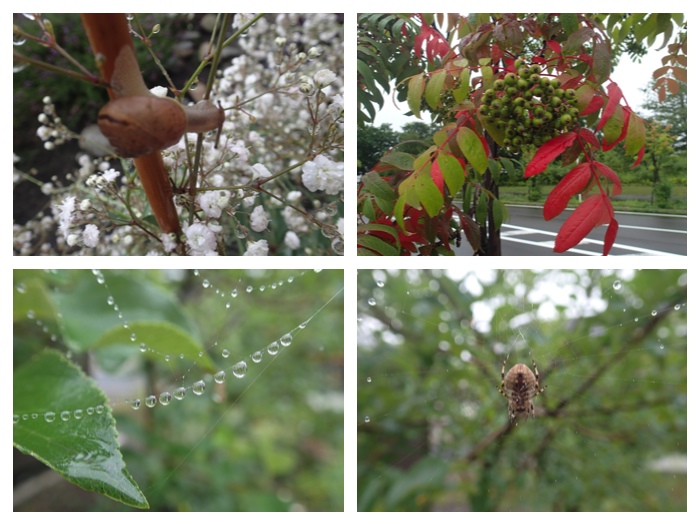
When leaves and flowers are wet, they are also beautiful. I am surprised to see the finely woven spider nets.
Long threads are connected between very far twigs and poles, I can not imagine how the spider connected it,
between far places compared with the very small body of the spiders.
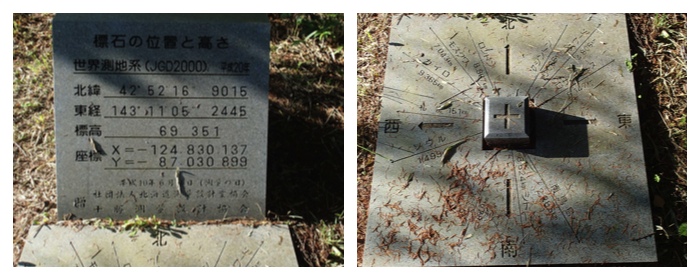
Yesterday afternoon, I walked to downtown to have a drinking party with my students. I passed the road in the field of Obihiro Agricultural High School, because it was the shortcut. Along the road there was a bench mark stone showing the latitude and longitude of this place. Several years ago before I live near here, I noticed this stone, but I have forgotten it. It is interesting that our place is almost equally far from eastern and western big cities of the world. I might feel as if I were in the center of the world.
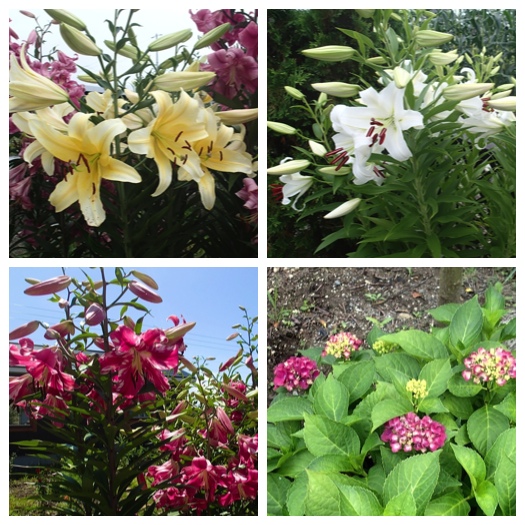
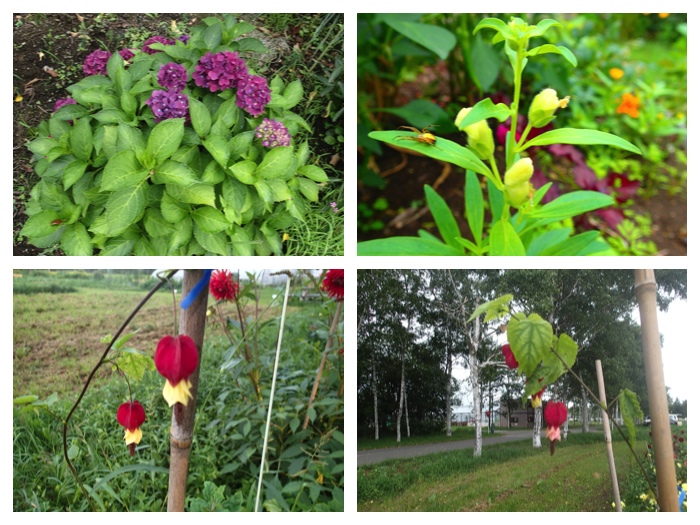
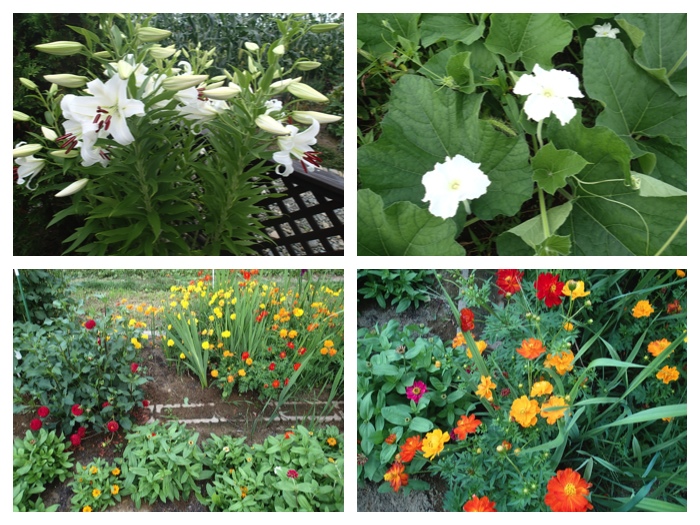
After rainy days, we have mid-summer again in Obihiro. Various flowers flourished in my garden. Lilies are most majestic, but small flowers are also cute.
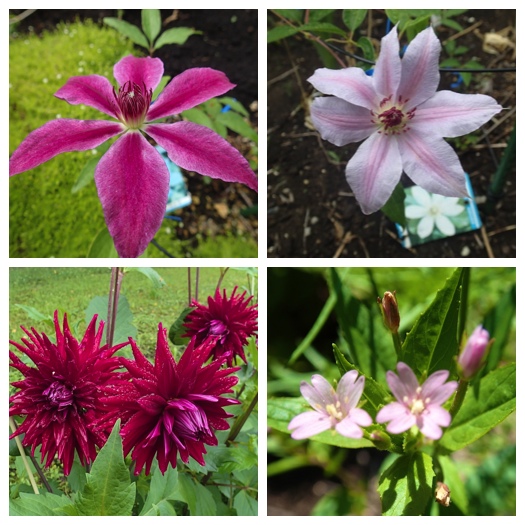
In the gardens of my house and of the junior course in my college, dwarf cosmos, zinnia, and dahlia are blooming. Abutilon had been transplanted from the pot in my office to the field, and now it has many flowers like a hat or lantern again.
From the middle of August to the end of September, we had a summer vacation in our college. We, employees of the university, had to attend the office even during the vacation time, though we had no classes or practice for students.
From September 10 to 14, I travelled to Nagoya to attend the scientific meeting of the Japanese Society of Soil Science and Plant Nutrition.
After coming back, I had spent my time mostly in my laboratory and in the field. In the laboratory, I did the analysis of sugar composition in the fermentation residue of biogas plant. I am familiar with the routine method of this analysis. However, the routine method is very tedious and many purification steps should be followed. Because I have so many samples now, I intended to simplify the procedure. I have spent too much time to elaborate the new method, and I almost felt that I should have better followed the routine method. On the last day of September, I could have satisfactory results in a new rapid method for sugar composition analysis.
From October, I will be busy again giving lectures, practices, and seminars to students.
In the field, I continued the yield survey of tomato grown with or without FA application. I am growing adzuki bean and carrot also in the field and their yields should also be surveyed soon.
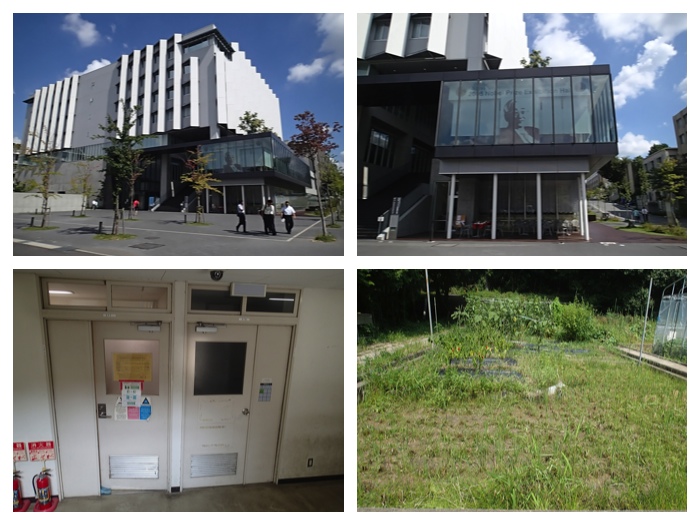
The Japanese Society of Soil Science and Plant Nutrition was held in Nagoya University, where I spent my undergraduate and graduate school age. I worked there for six years as an assistant professor. However, twenty-four years have passed since I left the university.
Many things have been changed there, and many beautiful and majestic buildings have been built there. It is thanks to the four Novel prize awardees from the university, two organic chemists, Prof. Noyori, and Prof. Shimomura, and two physicists, Prof. Kobayashi and Prof. Masukawa. We have to remember that their works were not accomplished by the abundant budget but they were brewed under the democratic atmosphere of the faculty of science.
I visited also the Faculty of Agriculture building, and confirmed my former laboratories and small rice field where I used to work.
The photo in the lower left corner shows the two laboratories: the left one is the C13-NMR laboratory where my wife used to work, and the right one with dark window is the X-ray diffraction laboratory where I used to work. It is interesting and funny that we were working in the neighboring rooms while we were studying at Nagoya University.
At that time we did not know each other.
The most important key word in the JSSPN meeting was the "frayed edge of clay minerals" which combine very firmly cesium ions in soil. I did not know the technical term. I have shown such structure of clay minerals in my lecture of Soil Science for Crop Production for many years, but I did not know that the site combines cesium. The pioneer scientist for this phenomenon is Dr. Maes in Belgium. I met him in 1990 when he attended the International Humic Substances Society held in Nagoya and the International Convention of Soil Science held in Kyoto. I talked with him at that time because I was one of the organizers of the IHSS meeting. I have forgotten that I met him long ago, and was surprised to find his name on the famous paper on the behavior of frayed edge.
In a waiting room of a clinic, a few months ago, I found a book of “Lion, witch, and wardrobe”, one of the “Chronicles of Narnia” series authored by C. S. Lewis of England. As I had not read the book, I started to read the book, and finished reading it during my two visits to the clinic. The waiting time in the clinic is usually very long in Japan.
Anyway, I found the book very nice. The description of seasons changing from winter to spring was very beautiful. Because I liked the book very much, I wanted to have my own volume of the book. I went to the book store, but I could not find the book there.
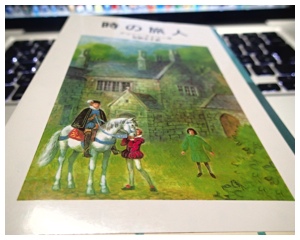
Instead, I could find a book entitled “Travellers in Time” authored by Alison Uttley, an English story writer for boys and girls. I bought the book, and found the book very nice, too.
To read the book, the reader needs the background information of the Queen of Scotland, Mary Stuart, who was executed by the Queen Elizabeth in the end of 16 century. A small girl born in an old family was given an ability to go and come back to the age and communicated with the people who were fascinated in the Queen Mary Stuart and devoted their lives. Description of the nature and life in a rural village in the central England was very beautiful.
The style of story, in which the characters of the story come and go between the real and imaginational worlds was common between the two books. I feel, it would be very nice if I can also travel between two different ages. I want to visit the age of long long ago.
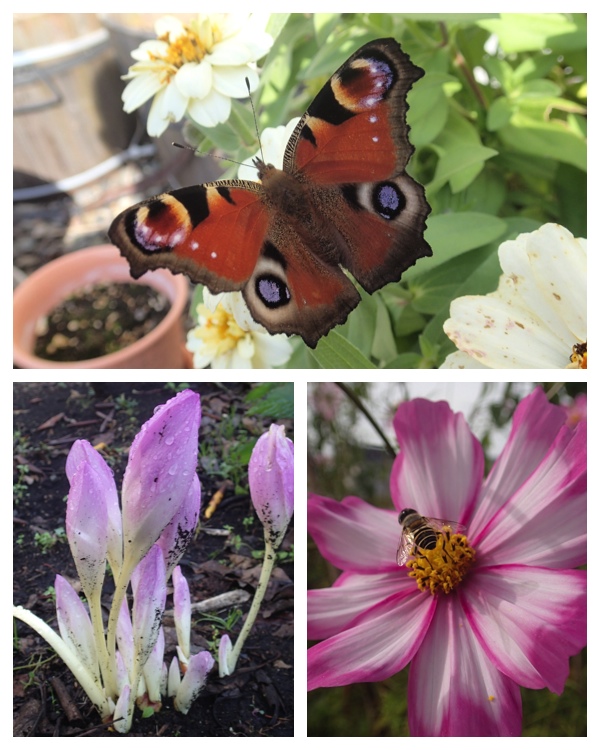
Around one week ago, whitish pale pink flowers came out from soil. The flower looks weak and shy. It has no leaves.
The flower is called Colchicum. It is toxic to animals due to its poisonous constituent, colchicine. The flower reminds me every year that it is already mid-autumn, and frost is coming soon.
I have also found a butterfly called "Inachis io", or "Peacock butterfly" in Japanese. They survive until late in autumn. It was busy collecting honey from Zinnia.
The larva of the butterfly has eaten the leaves of elm and nettle which are very common in our place. .
Bees are also busy collecting honey and pollen from cosmos flowers preparing for the long winter.
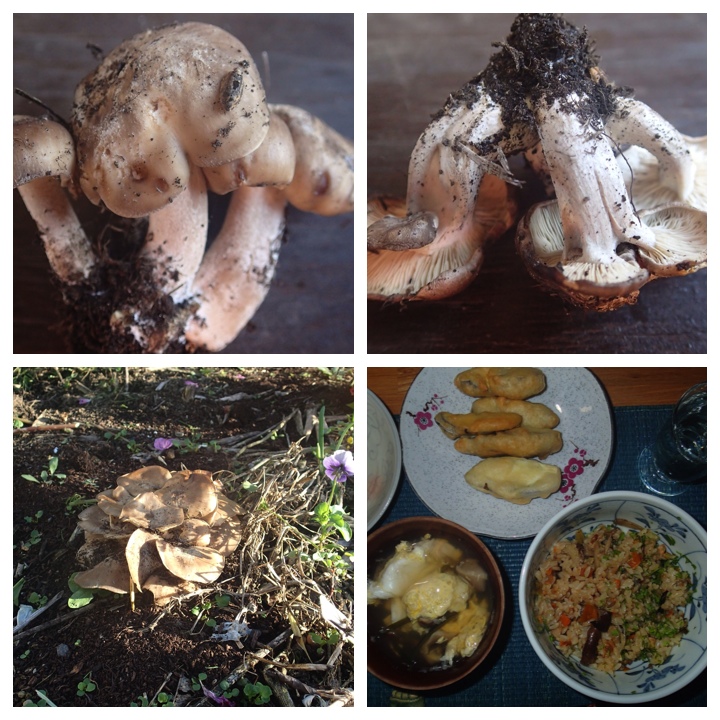
Mushroom came out from the soil in my garden. I neither know its name nor whether it is edible or not. One should be very careful when he consider to eat unknown mushroom... However, we have eaten it at last. It was delicious!
My wife has cooked it. It had good flavor and taste. The mushroom was boiled with rice and carrot spiced with leek and soy sauce. We had it for our evening dish. The soup was cooked with egg and "Shiitake", very popular mushroom sold in market. Another dish is fried eggplant also from our garden. Transparent liquid is Japanese Sake. We still do not know the name of the mushroom from our garden. Maybe it is a kind of "Shimeji".
Our digestion system or neural system showed no problem after the dinner. I admire the braveness of my wife who decided to cook it.
Long ago, while I was a high school third year student in my home town......
On some day in spring, I found a long-legged wasp making a small nest under the eaves of my parents’ house. I can not remember whether my parent ordered me to remove the nest or not. Anyway, I removed it, but after some consideration I brought it into my room and attached it on the ceiling of my room with an instant glue.
I left the window of my room open. Soon after I put it in my room, the owner of the nest came into my room and continued nest making. Though the wasps are considered dangerous, I considered that if I do not irritate them, they will not bite me. Therefore, I started to raise wasps in my room.
The nest became bigger day by day, and the number of wasps also increased. I never closed the window of my room, so that wasps can go and come back freely for hunting. At that time I was allocated a small room in the second floor, and my family members seldom came into my room. They said nothing for raising wasps in my room. In summer, wasps were very active, and room mat below the nest became dirty, and I removed it and put it aside. I slept not below the nest, but at the edge of the room. I behaved always calmly in my room. I had to prepare for the entrance examination of the university, and all I had to do was reading text books or writing or calculating exercise problems.
After fall, the number of wasps decreased, and in winter only a few wasps remained. In mid-winter they did not go out from my room and attached to the sunny window glass. In the early spring of next year, I passed the examination of the university. I considered that I can not take care of the wasps after I enter the university. So while the wasps were out of my room, I removed the nest and I put it again on a tree twig very far from my house.
During my trial of wasp raising, I did not take the record of the behavior of the long-legged wasps, because I raised them only from my curiosity, and I was busy preparing for the entrance examination. The wasps never stung me while they nested in my room. I heard that long-legged wasps are calm charactered compared with vespine wasps. Maybe it was possible under very special circumstances between a calm boy and a relatively calm wasps.
In Hokkaido, we can not find long-legged wasps. Instead we see only dangerous vespine wasps, honey bees and bumble bees.
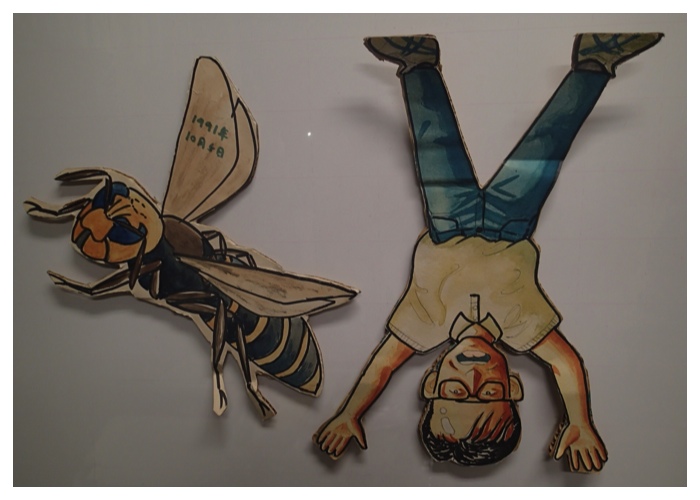
The lower photo has no relationship with the above sentence. The wasp in the photo is a vespine wasp which attacked my student long ago. It will be another long story.
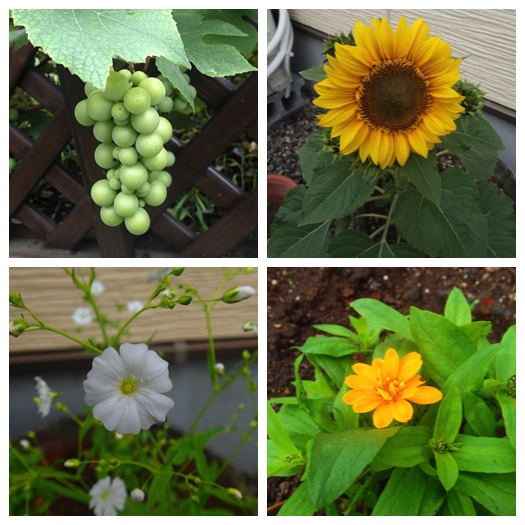
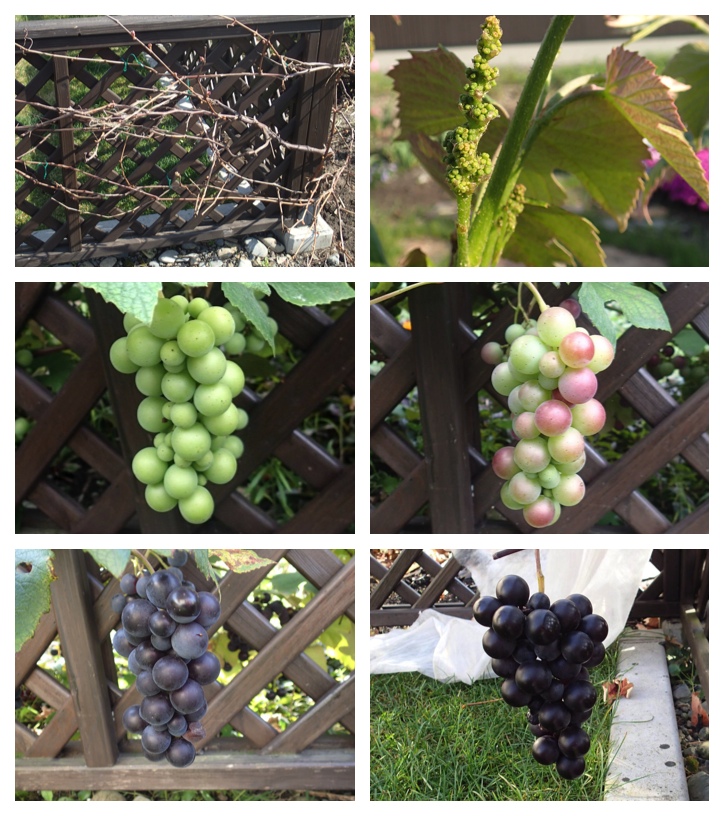
It was given to us by our neighbor aunty. She shared us a portion of grape stubble in her garden three years ago. We planted it near the lattice of dog-run in my garden, so that the grape vines can be supported by the lattice.
Three years have passed since we planted the grape. We had a good yield this year, and we could enjoy the harvested grape with our grandsons. Our house is built on a stony lowland along a big “Satsunai river” in Obihiro. Therefore, the soil contains a lot of round shaped gravels and is not so fertile, but I have heard that grapes are adapted to such stony land.
I have taken the photos of our grapes from time to time. It started to bear buds in the end of May, flowered in early June, had a green bunch in August, and become very sweet in November. Now grape vines are released from the lattice, and put on the ground so that they can survive the severe coldness.
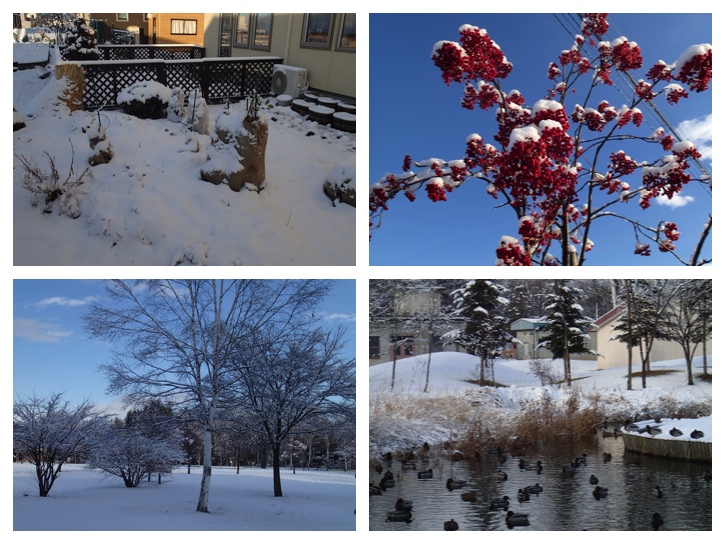
In the middle of October, we had an irregular snow, and one week ago we had a regular snow in the end of November. The season has just turned from autumn to winter in Tokachi.
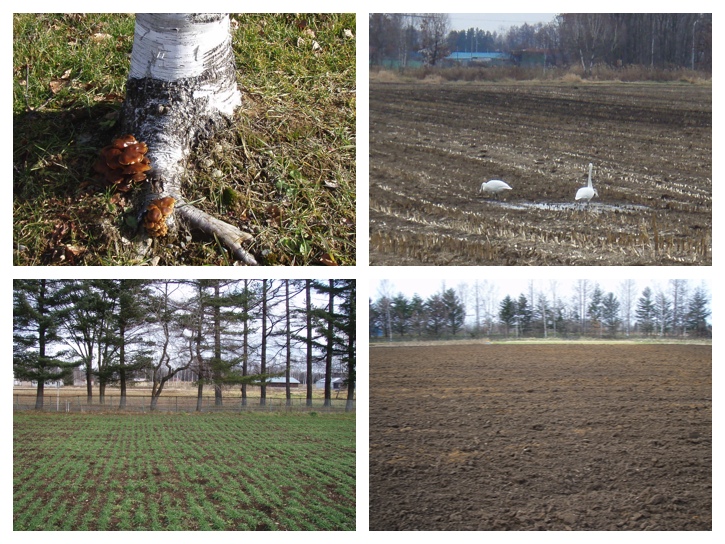
Before snow I walked in the campus of my college, and found swans feeding the fallen seeds of dent-corn. Some edible mushroom was growing on the root of white birch, but I did not harvest it because many people have already noticed it.
All crops have been harvested in the field and plowed for the next season. Winter wheat has formed rosette and are ready for surviving the long winter under snow.
Many wild ducks were gathering in the biotope pond, but I do not know how they survive the mid-winter.
The House of Japanese Councilors has passed the law of secrecy keeping related to national defense. I think most of Japanese people are against this law.
This law was pushed by the liberal democratic party of Japan, but this party has actually nothing to do with liberalism or democracy. The major concerns of this party are the close tie between Japan and USA, and the profit of Japanese conglomerates.
The present prime minister, Mr. Abe, is the grandson of former prime minister, Mr. Kishi, who passed the Security Treaty between Japan and USA in 1960. Mr. Kishi was originally one of the top government official during the World War II, and was once arrested by occupation forces of USA but released afterwards to prevent the communistic trends in Japan. Mr. Kishi could become a prime minister thanks to the abundant financial support from CIA. Mr. Abe, the present prime minister, is very proud of his grandfather, and he wants to succeed the vision of his grandfather. He wants to change the Constitution of Japan, strengthen Japanese army and enable it to fight against foreign countries, introduce TPP and promote the free trade between Japan and USA and the extinction of agriculture in Japan. He also admits the operation of atomic power plants in Japan to keep the atomic fuels in hand so that it may also be used for atomic weapons. None of these things are wanted by Japanese people.
Many of Japanese people might have voted for the liberal democratic party in last July, expecting the recovery of economics after the earthquake disaster on March 11, 2011, but they have never expected such reckless action by the ruling party. I think, Mr. Abe also holds already many seriously important secrets between himself and USA agency, that is why he wanted to push the secrecy law.
I was also surprised to read the editorial article on “Yomiuri-Shimbun” newspaper, which I bought on my return trip from Sapporo to Obihiro. Editorial board of the newspaper wrote that opposition party members who are behaving to retard the voting on the secrecy law are against the Constitution because the result of the voting is obvious according to the numbers of parliamentary members of ruling and opposition parties. According to this editorial opinion, every thing can be approved by the ruling party.
The attitude of “Yomiuri-Shimbun” coincides with the history of its company. This newspaper company was owned by Mr. M. Shouriki, who was also an important governmental official during the World War II, and after the war arrested for promoting the war like Mr. Kishi, but released by USA to prevent the communism in Japan. He was also said to be an agent of CIA and promoted the introduction of nuclear power in Japan under the name of its peaceful use.
I think that Japan is in the crisis of democracy and peace.
While the politician for the atomic power generation visited Fukushima, people against the atomic power also assembled in Fukushima
On the day when I visited Minami-Soma (March 8), the prime minister of Japan, Mr. Abe visited Iwaki. He ate the fresh fish caught in Onahama port and admired the good taste. On the same day, people who are against the atomic power plant gathered in Kohriyama city and had a big assembly.
I did not know such schedules, but it was very lucky for me that I visited Minami-Soma on that day. If I had visited Iwaki on March 8, I could not visit the places freely due to police control. If I had visited Kohriyama as there is an agricultural experiment station there, I might be suspected that I attended the assembly of the people against atomic power plant.
Anyway, whenever politicians visit Fukushima, they eat fish or agricultural products from the area affected by radio-activity, and say “Good. No problem”. I understand that it might be their performance to dispel the peoples anxiety. However, when politicians say such word, it may sound false and have counter effects. Especially when the politicians are for the promotion of atomic power plant, their words for sympathy expression sound doubtful.
I wonder whether the liberal democratic party of Japan has ever apologized the victims of atomic power plant incidence for the fact that they have promoted the atomic power plant without telling the dangerous aspects of its operation to the citizens. I think they have not. They have ignored the occasion of apology, because they were not the ruling party when the earthquake and the meltdown of the atomic power plants occurred.
Without reflecting their past politics for atomic power generation, how can they express their sympathy to the victims?
Only two days after the third memorial day (March 11) of the Great East Japan Earthquake, Prime Minister Abe announced that his government concentrates every effort to re-start the operation of the two atomic power plants located on the Satsuma peninsula in Kagoshima prefecture, Kyushu. They will urge the safety testing process by Nuclear Regulation Authority. Not only the people in Fukushima but also the conscious people must have been disgusted or got angry.
History of Minami-Soma and the decontamination works in the area
On March 8, I visited Minami-Soma city, passing Kawamata town and IIdate village. These community have the area where inhabiting is restricted due to high radio-activity.
In the central area of Minami-Soma, Hara-machi, people are allowed to live there continuously, but in the southern area, Odaka-machi, living is not allowed.
I visited the museum of Minami-Soma city. It was a beautiful museum in the natural landscape. Exhibitions in cultural, and natural historical area were nice and excellent. They showed me a video recording the people’s festival in old Samurai costumes and riding horses.
I also learned that Soma area had been affected seriously by the famine occurred in the end of 18 century (Famine in Tenmei ages). However, the people in Soma area recovered from the disaster of famine thanks to the guidance of Mr. S. Ninomiya, a famous leader of farmers.
The people in Minami-Soma are facing the crisis to be recovered again. The present crisis seems even more difficult, because the agricultural lands have been contaminated by radio-activity and agricultural production can not be started immediately.
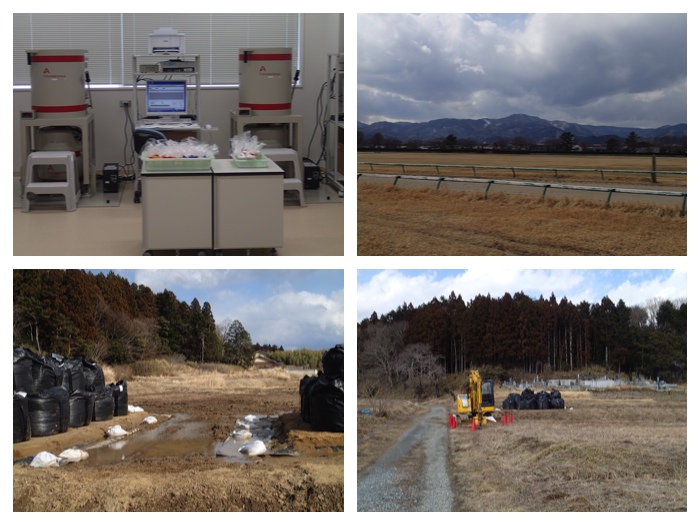
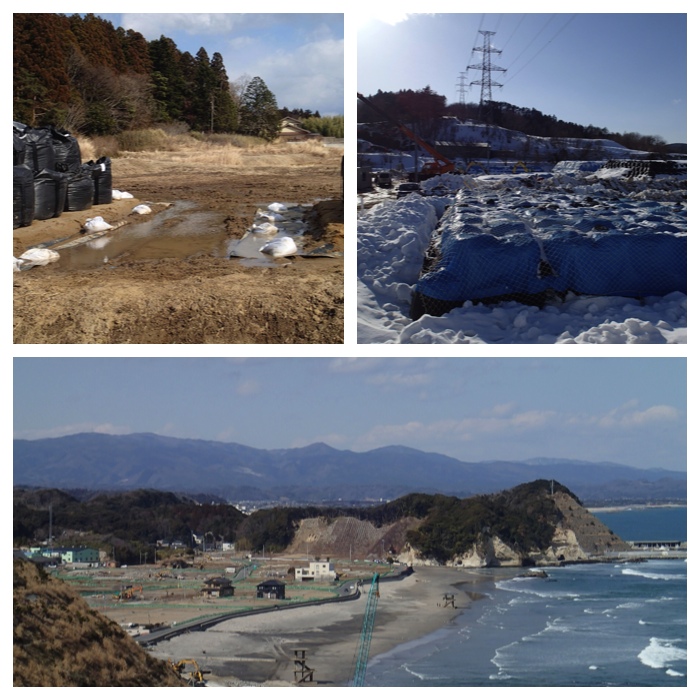
After visiting the museum, I went to the southern Odaka area. In Odaka area, de-contamination work of paddy fields have been started. Decontamination work removes the surface soil up to 5 cm, which produces 50 kg of polluted waste soil from 1 square meter, equivalent to 50 tons from 1000 square meter. The polluted waste soils have been packed in a flexible container bags and piled in the paddy field. The most serious problem is how to manage these waste soils.
Disaster area at Toyoma in Iwaki city and the tale of edible soil
On March 9, the next day when the prime minister visited Iwaki, I also visited the same city driving the express way from Fukushima city. Iwaki-city and Minami-Soma city are actually very near, but the traffics between the two cities are stopped due to the meltdown of Fukushima Dai-ichi Atomic Power Plant.
After arriving the Iwaki city, I visited first the archaeology museum of the city as well as the coal and fossil museum. I asked the present situation in Toyoma region in the city, which was destroyed severely by the Tsunami. I also asked whether they have any information on edible soils which might have been produced in the area in ancient Johmon period, because the name of the area “Toyoma” means the “Place where edible soil is found” according to the Ainu language. More than two thousand years ago, northern part of Japan was inhabited by Johmon people who are considered to be in a close relation with Ainu people. Iwaki city is also famous for the production of diatomaceous earth.
I have visited the places with similar names in Aomori and Iwate prefectures six months before the Tsunami, but this place in Iwaki had not been visited because it was too far for me. I felt very sad that the place where I was very much interested was attacked by the Tsunami and suffered from severe damage.
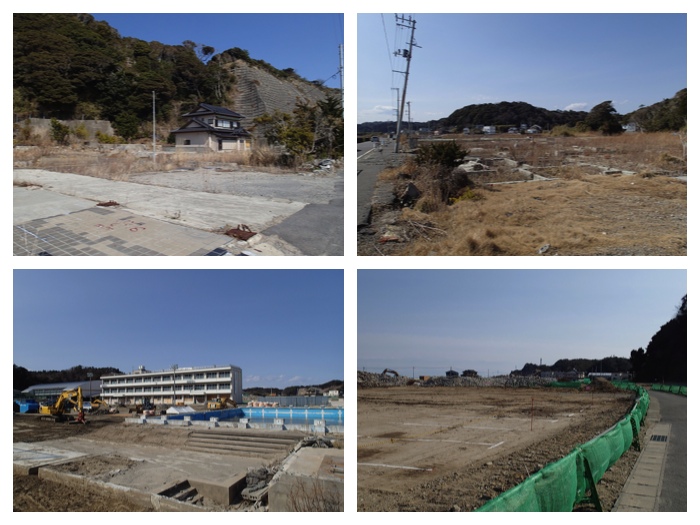
I visited the Toyoma area after visiting the museums. The houses in the coastal village have been completely destroyed and only the basement of the houses were remained. A few houses have been reconstructed again. The buildings of the Toyoma middle school were also severely damaged, and the reconstruction has been recently started.
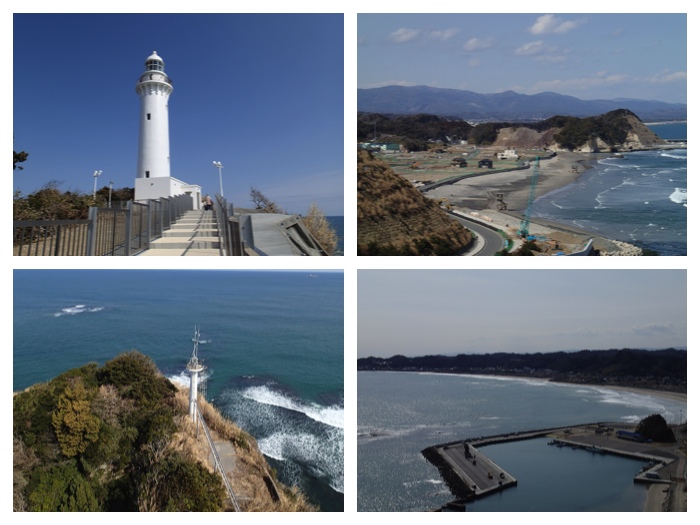
There was a beautiful light tower on the top of a hill facing the sea and I climbed it. The scenery from the light tower was very beautiful, and the sea was very calm and it was almost incredible that the sea brought the cruel Tsunami and destroyed the whole village.
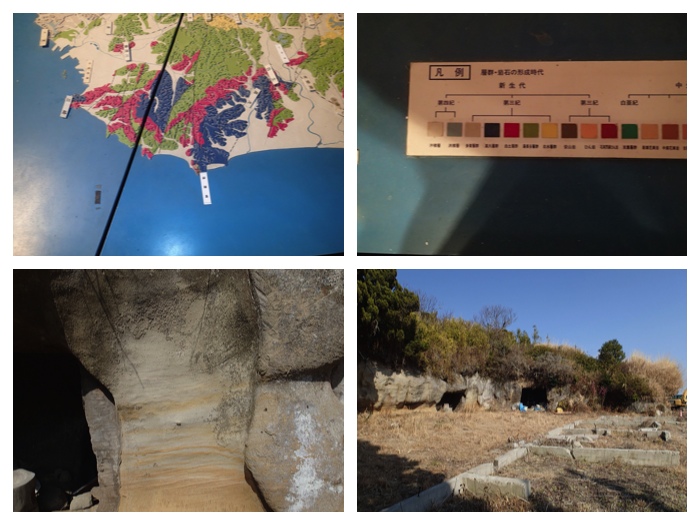
Near the temple of the village, I found a lateral holes bored in the cliff. It is said there are many holes used as graves by ancient people in this area. The soil of the cliff was white and relatively soft. I suspected it might be edible soil, but I am not sure.
During my visit in Fukushima, I visited three museums in Minami Soma and Iwaki cities. In either museums, the monoliths of shell mounds (kitchen midden) made by Johmon people were displayed. Various earthen wares made in the early period of Johmon age (8,000 years ago) and following ages were also displayed. Stone wares in very old ages (20 - 30 thousands years ago) have also been excavated. Such age was even before the people passed the frozen Bering strait and stepped into the continents of America. Ancestor of such people might have also passed this place, and from the sea shore of this place they might have imagined the new place beyond the Pacific ocean. It is too romantic to imagine such scenes. Excavation of kitchen middens and earthen wares proves that this place has been very comfortable place for the people to live for thousands of years.
The pile of kitchen midden stopped around 2000 years ago, which means that the life style of Johmon people changed around that age, or might mean that the Johmon people had been expelled from the new Yayoi people who came from the continent with the techniques related to agriculture. I want to believe that the Johmon people were not expelled but mixed with the Yayoi people and introduced agriculture in their life style.
The culture of Ainu people is also still inherited in the Japanese culture. Even the very important word “Kami” (God) might come from the Ainu word “Kamui”. Ainu people in Hokkaido are known to be very religious. Names of places especially related to natural topography inherit Ainu names. I think the features of the body and faces of Japanese people also inherit the characteristics of both Yayoi and Johmon peoples. The people who inherit Johmon blood might look more handsome and hairy, and the people who inherit Yayoi blood might look calmer and have less hair.
In the history of Japan, Johmon age lasted around 6000 -7000 years, and after the coming of Yayoi people, only 2000 years have passed. Including the life in stone age, human life flourished in the coastal area of Fukushima for around 30,000 years. It is too silly to have these happy and fertile lands destroyed by the radio-activity.
Photo below: Fisher village washed away at Toyoma, Iwaki city
Upper left: Paddy field in Odaka area, Minami-Soma under decontamination work
Upper right: Bags of polluted soils piled on paddy fields at Yamakiya village in Kawamata town
On the last day of my trip to Fukushima, I visited the soil science laboratory of Tohoku University because my trip was via Sendai airport.
The staffs of the laboratory are Professors Mr. Nanjo, Mr. Takahashi, and Mr. Kanno. They have contributed very much to the recovery of the agricultural land affected by Tsunami.
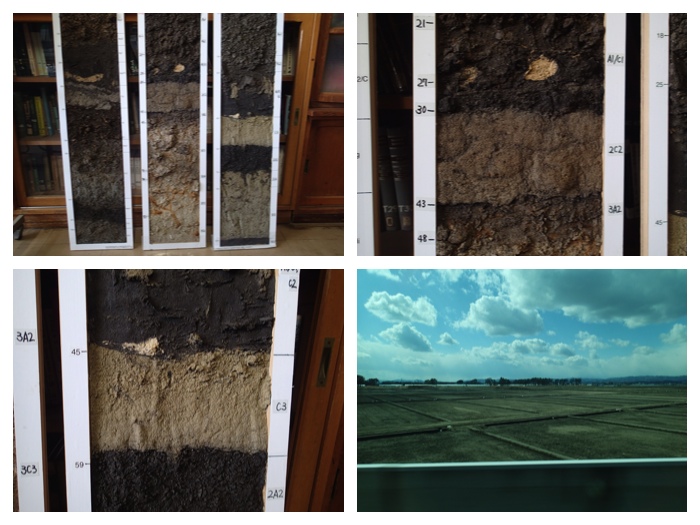
They showed me various achievements made by them. I was very much interested by the soil monoliths made by them at the agricultural lands in Sendai plain near the coast. Three soil monoliths made at Watari, Sendai, and Shichigahama, all contained a thick sand layer at the depth of 40 - 50 cm. Above the soil layer they found a typical volcanic ash tephra blown out from Towada volcano in AD 915 (Towada a tephra). From this fact, they have concluded that the sand layer was deposited due the Tsunami caused by the gigantic earthquake occurred in AD 869 (Johkan 11). The agricultural fields in Sendai plane are now under the work of decontamination and rehabilitation as shown in the photo below. I took the photo near Sendai airport from the window of the train connecting airport and Sendai city.
In the archives of old documents, records of earthquakes are sometimes remained. Japanese classical essay “Hohjohki” written by Kamono-Chomei records the big earthquake occurred in western Japan in 1185. Mr. Townsend Harris, the delegate from USA to open the trade between two countries in the end of Edo era also recorded the big earthquake occurred around Tokyo in 1858. The two big earthquakes occurred in North-east Japan in 1896 and 1933 were famous related to the birth and death years of famous Japanese poet and children’s story writer, Mr. Kenji Miyazawa. The earthquake and Tsunami occurred in 1896 were too serious that there is a monument stone for this earthquake in Hachinohe.
Recently, there were also big earthquakes in Hokkaido in 1993 and 1994. Due to the earthquake occurred in 1993, the building in which my laboratory was located made fire. The earthquake in 1994 was famous for its serious damage to Okushiri island due to Tsunami and fire. Soon after these earthquake, in 1995, gigantic earthquake occurred in Kobe and Awaji island (Hanshin-Awaji earthquake). The earthquake which hit north east Japan in 2011 was too big that even myself who live in Obihiro felt that it occurred directly beneath our ground.
Also in oversea countries, gigantic earthquakes occurred recently
in China (2008), Sumatra Indonesia and Thailand-Malaysia border (2004 and 2009), Iran (2003 - 2012), Samoa (2009), New Zealand (2010 and 2011), Mindanao, Negros, and Bohol in the Philippines (2010, 2012 and 2013), Turkey (1999, 2010) and Haiti (2010).
Under such situation, we may anticipate any worse disaster in the recent future, but I do not want to meet such occasion and do not like to die in the disaster.
I wonder if the people who promote atomic power generation are too optimistic, too brave, or under special situation to promote it without considering the safety and lives of people under the control of big power in the world.
However, even more fierce catastrophe will be brought by the war between the nations or the meltdown of atomic power plants. There are politicians and people who do not care about these matter. The problem is some international enterprises expect their profit from the disturbance in the world.
Home page of Soil Science laboratory of Tohoku University is as follows. It provides many useful informations for the people interested in fundamental soil science. Home page of Soil Science laboratory of Tohoku University